
Technology and Mental Health: Helpful Tool, Harmful Habit or Both?
Technology can connect a rural patient with a clinician, help a person organize coping skills, or provide a community that is hard to find locally. The same device can interrupt sleep, amplify comparison, collect sensitive disclosures and keep attention locked into an endless feed. The useful unit of analysis is not “technology.” It is the product, person, purpose and pattern of use.
Four tools, four different questions
Telehealth
Can it connect this person with an appropriately licensed clinician in a private, reliable setting?
Social media
Does it create meaningful exchange, or mainly comparison, conflict and compulsive checking?
Mental-health apps
Is the intervention supported, accessible and clear about data practices?
AI chatbots
Is the task low-stakes and bounded, with a human path when the answer could cause harm?
Telehealth can widen access without removing every barrier
Remote care can reduce travel, scheduling and geographic barriers. It can also fail when broadband is unreliable, a person lacks privacy, insurance coverage is unclear, accessibility needs are unmet or a clinician cannot practice across a state boundary. Emergency planning matters because the clinician may be physically far away. The value is real, but it depends on the service and the patient's circumstances.
Social media outcomes are not one-directional
Online communities can supply identity, information and support, especially when local connection is scarce. Harassment, social comparison, disrupted sleep and design features that reward prolonged engagement can work in the opposite direction. HHS guidance emphasizes healthier routines and safer product design rather than claiming one universal hour limit solves every problem.
Advertisement
Read HHS's current screen-use action and guidance. Open the official resource.
Public information; no purchase required.
AI can be convenient without being established treatment
An AI tool may help brainstorm questions for an appointment, translate general information or prompt a journaling exercise. Those are possible conveniences, not proof that a particular system treats depression, anxiety, trauma or another condition. Models can sound certain while being wrong, miss crisis signals, mirror a user's harmful premise or change without notice. High-stakes decisions need qualified human care and evidence for the specific product and use.
Read the privacy policy like a mental-health document
| Question | Why it matters |
|---|---|
| What is collected? | Messages, symptoms, voice, location and device data may reveal more than a username. |
| How long is it retained? | Deletion from the screen may not mean deletion from servers or backups. |
| Who receives it? | Vendors, advertisers, employers, insurers and researchers have very different roles. |
| Can it train a model? | Sensitive conversations should not silently become training material. |
| Can it be exported or deleted? | A meaningful control must be discoverable and usable. |
A privacy badge is not enough. Look for specific language about collection, retention, sharing, security, deletion and secondary use.
Audit the result, not just the minutes
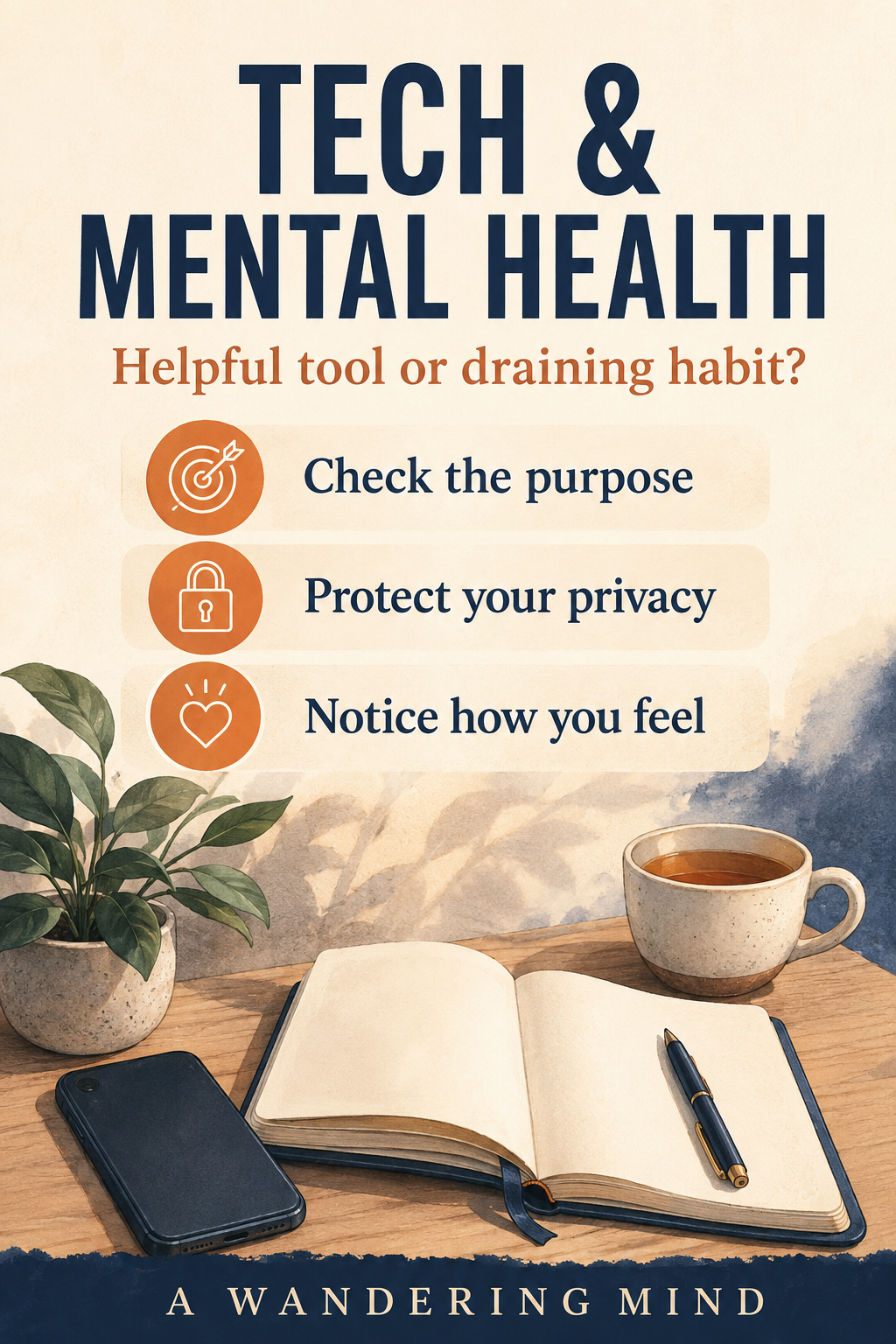
- What did I intend to do, and did the tool help?
- How do I feel immediately afterward: informed, connected, agitated, numb or compelled to continue?
- Did it replace sleep, movement, treatment, work or an in-person relationship?
- Which notifications and recommendations are useful enough to keep?
- Can I create friction—scheduled checks, a device-free bedroom or removing the most compulsive app?
Advertisement
Review NIMH's framework for evaluating mental-health technology. Open the official resource.
Public information; no purchase required.
A healthier environment is designed
Self-control is not the only lever. Families can agree on charging locations and quiet periods; clinicians can recommend vetted tools for defined goals; employers and schools can limit after-hours expectations; and product makers can reduce manipulative engagement patterns. When mood, sleep or functioning is worsening, the answer may be a professional assessment rather than another app.
Sources and editorial notes
- HHS — 2026 screen-use action
- HHS — Social Media and Youth Mental Health
- NIMH — Technology and the Future of Mental Health Treatment
- NIMH — mental telehealth availability
- FTC — inquiry into AI companion chatbots
- 988 Lifeline
Sources checked September 7, 2026. Published by A Wandering Mind. Editorial review is not medical, legal, tax or financial review. No affiliate links or sponsorship are included.