
Loneliness and the Brain: Why Social Connection Matters
A person can feel lonely in a crowded room and content during long stretches alone. Loneliness is the distressing sense that one's relationships do not meet a desired level of closeness or belonging. Social isolation is more objective: too little contact, support or participation. They can occur together, but they call for different questions.

Connection is associated with health
In a CDC analysis of the 2022 Behavioral Risk Factor Surveillance System in 26 states, roughly one in three adults reported loneliness and about one in four reported inadequate social and emotional support. These are dated, self-reported survey estimates, not a complete national census; the survey measured loneliness indirectly through feeling socially isolated. Major public-health reviews associate loneliness and social isolation with worse mental and physical health outcomes. The evidence does not mean loneliness mechanically causes every illness or that a single friendship prevents disease. Age, disability, bereavement, poverty, discrimination, caregiving, transportation and health can influence both connection and outcomes.
How the relationship may work
Stress regulation
Belonging and reliable support may influence how often the body remains on alert.
Behavior
Other people can support meals, sleep, movement, appointments and help-seeking.
Cognition and mood
Conversation and shared activity may provide stimulation, meaning and feedback.
Practical support
A connected person may receive help during illness, job loss or a daily problem.
These are plausible and studied pathways, not a diagnostic scan of a lonely brain.
Advertisement
Read the Surgeon General's full social-connection advisory. Open the official resource.
Public information; no purchase required.
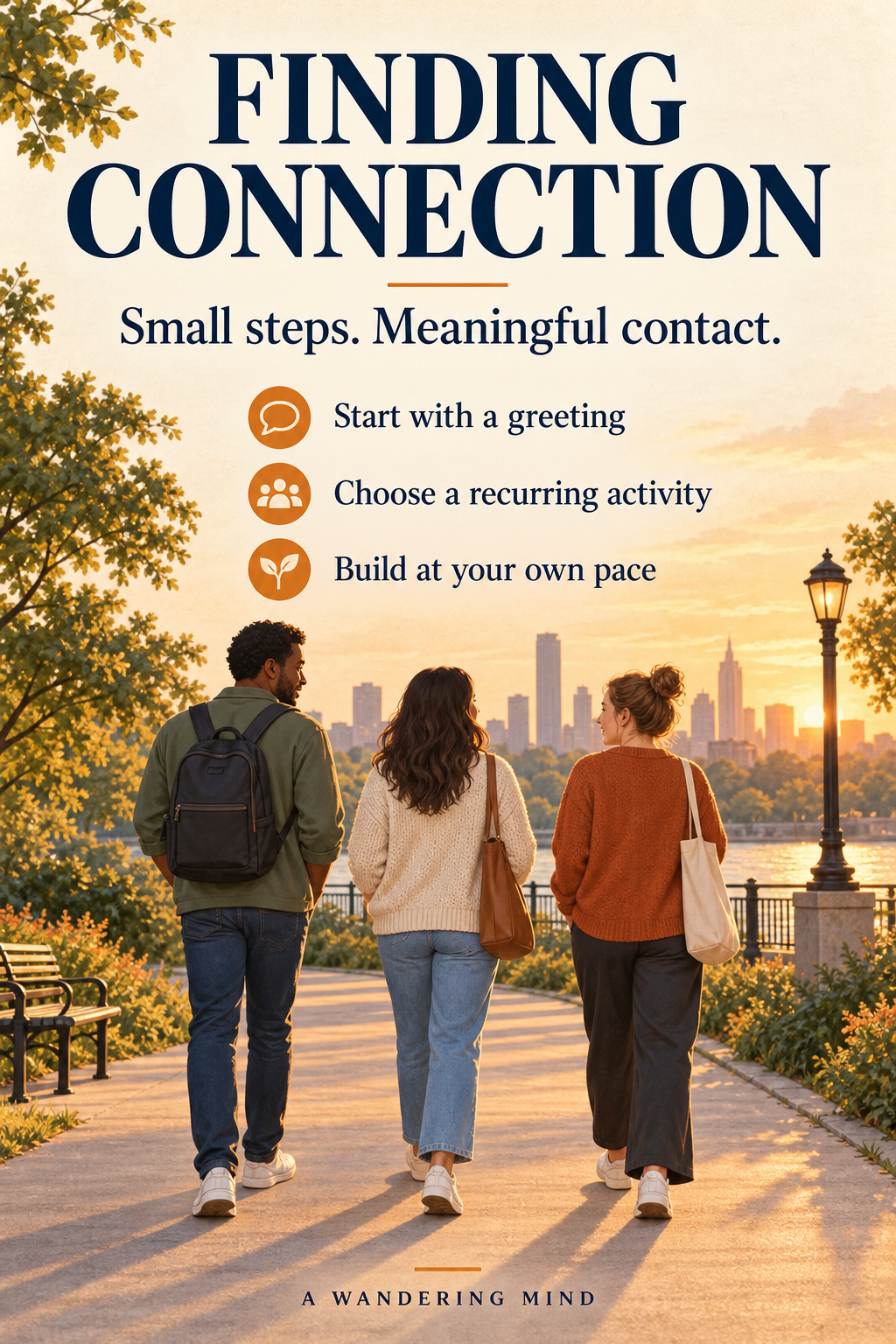
A connection ladder
The following ladder is an editorial planning heuristic, not a validated clinical scale. Start at the least intimidating rung that can be repeated:
- Presence: spend time in a familiar public place without requiring conversation.
- Recognition: exchange a greeting with the same neighbor, worker or group.
- Participation: join a recurring class, volunteer shift, faith gathering, club or peer group.
- Contribution: take a small role that makes attendance useful to someone else.
- Reciprocity: invite one person into a repeated, low-pressure plan and allow the relationship to deepen gradually.
Aim for repeatability, not an instant best friend
Recurring low-pressure contact is a promising route because familiarity and trust often need time. It has not been proven universally superior to every other intervention. A meaningful first goal may be one reliable weekly interaction, reconnecting with someone safe, or attending a group three times before deciding it is a poor fit.
Digital contact: judge the pattern
| Pattern | Possible signal |
|---|---|
| Active exchange with known people | May support an existing relationship. |
| A moderated peer group | May provide belonging and practical information. |
| Endless passive comparison | May leave mood or self-worth worse afterward. |
| Online contact replacing every local option | May signal access barriers or avoidance worth exploring. |
This table is a practical heuristic. Effects vary by person, platform, content and context.
Barriers are not personal failure
A person cannot simply mindset their way around inaccessible buildings, unsafe neighborhoods, discrimination, caregiving schedules, hearing loss, chronic illness, language barriers or lack of transportation. Useful solutions may include accommodations, paratransit, home visiting, community health workers, benefits, accessible groups and professional treatment alongside individual effort.
If withdrawal is connected with trauma reminders or feeling unsafe even in safe settings, our guide to PTSD symptoms, treatment and supporting recovery explains why care may need to address more than a shortage of social invitations. Loneliness alone does not establish a PTSD diagnosis.
Advertisement
Use HHS's practical social-connection resource list. Open the official resource.
Public information; no purchase required.
A small plan for this week
- Name the missing type of connection: companionship, practical help, intimacy, shared identity or purpose.
- Choose one recurring setting rather than five one-time events.
- Make one specific invitation with a time and activity.
- Ask a clinician about hearing, depression, anxiety, grief or mobility when those are barriers.
- Measure success by showing up and learning, not by instant chemistry.
Sources and editorial notes
- U.S. Surgeon General — Our Epidemic of Loneliness and Isolation
- CDC — social-connection risks and health effects
- CDC — promising approaches
- HHS — social-connection resources
- 988 Lifeline
Sources checked September 7, 2026. Published by A Wandering Mind. Editorial review is not medical, legal, tax or financial review. No affiliate links or sponsorship are included.