
You’re Asking AI the Wrong Question
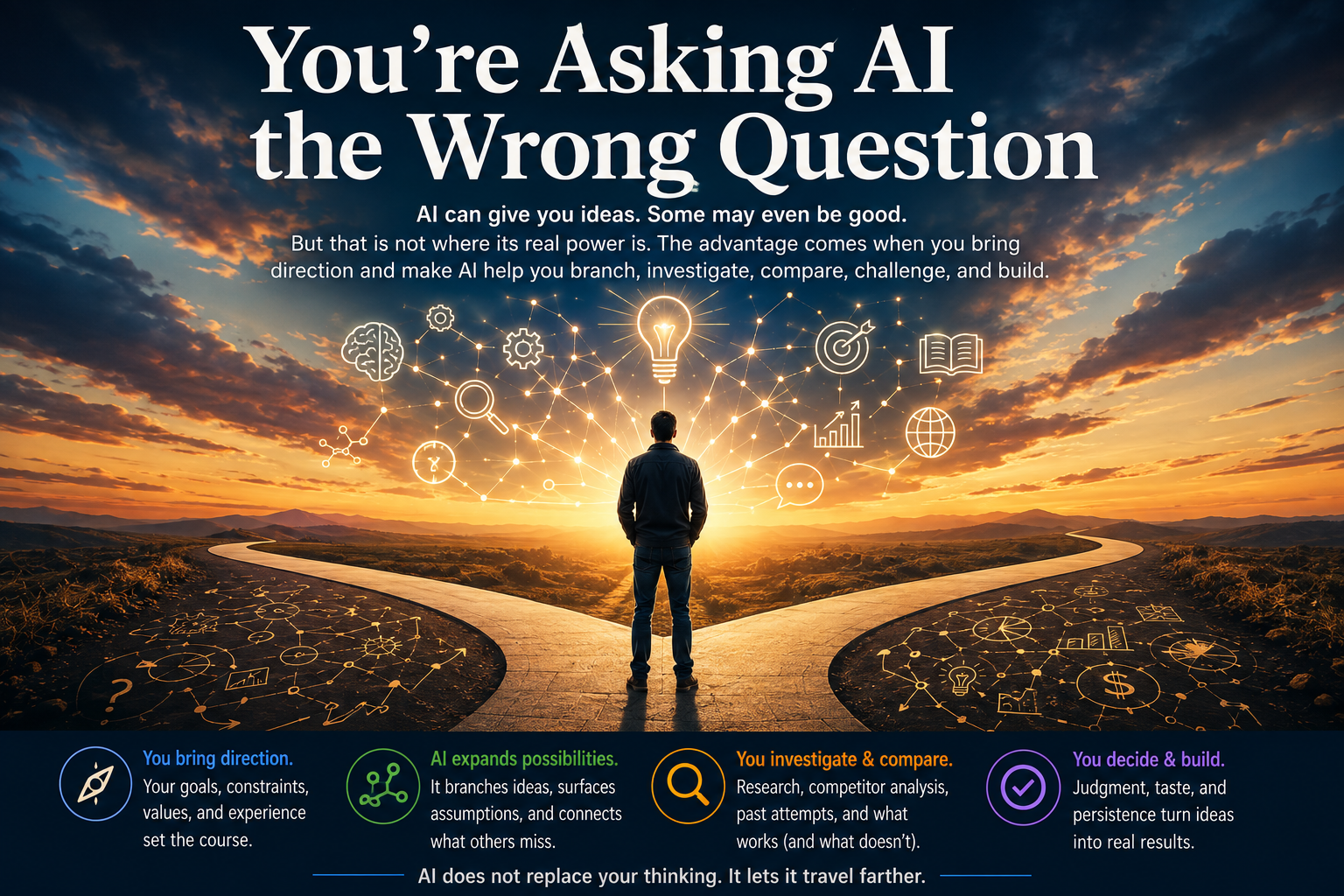
AI can give you ideas. Some may even be good. But that is not where its real power is. The advantage comes when you bring direction and make AI help you branch, investigate, compare, challenge, and build.
There is a tempting way to use artificial intelligence that sounds almost magical: open a chatbot and ask it for a brilliant business idea, a breakthrough app, a new book concept, a research project, a product nobody has built, or the next thing that will change your life.
It will answer. Quickly. Confidently. Usually with a list.
That can feel like creativity on demand. Sometimes it even is creative. But the mistake is assuming that the list is where the value is.
I started with a harsher version of this argument: AI will not come up with good ideas for you. The evidence forced me to soften that sentence. Current systems can generate ideas that people judge as novel, useful, and occasionally better than what humans produce on the same task. Pretending otherwise would make the rest of the argument weaker.
The better claim is this: AI can generate possibilities. It is still far less dependable at knowing which possibility deserves your time, what makes it important, what tradeoffs you should accept, and whether the result is worth bringing into the world.
The uncomfortable correction: AI can produce good ideas
A large study published in Nature Human Behaviour compared 9,198 humans with more than 215,000 large-language-model observations on a divergent-creativity task. Human creativity was slightly higher on average, and the difference became more pronounced at the highly creative end of the distribution. Attempts to boost model creativity through persona prompts and other prompting strategies produced mixed results.1
Another 2026 study, this time using a human dataset of 100,000 participants, found that several leading language models could exceed average human scores on the Divergent Association Task. But the strongest models still failed to outperform the more creative portions of the human population.2
So if the question is simply, Can AI ever generate an original-looking or genuinely useful idea? the answer is yes.
That distinction sounds small. It is not.
Generating twenty directions is cheap. Choosing one means accepting opportunity cost. You may spend months building it, years studying it, money testing it, or your reputation defending it. At that point, “the chatbot suggested it” is not much of a decision process.
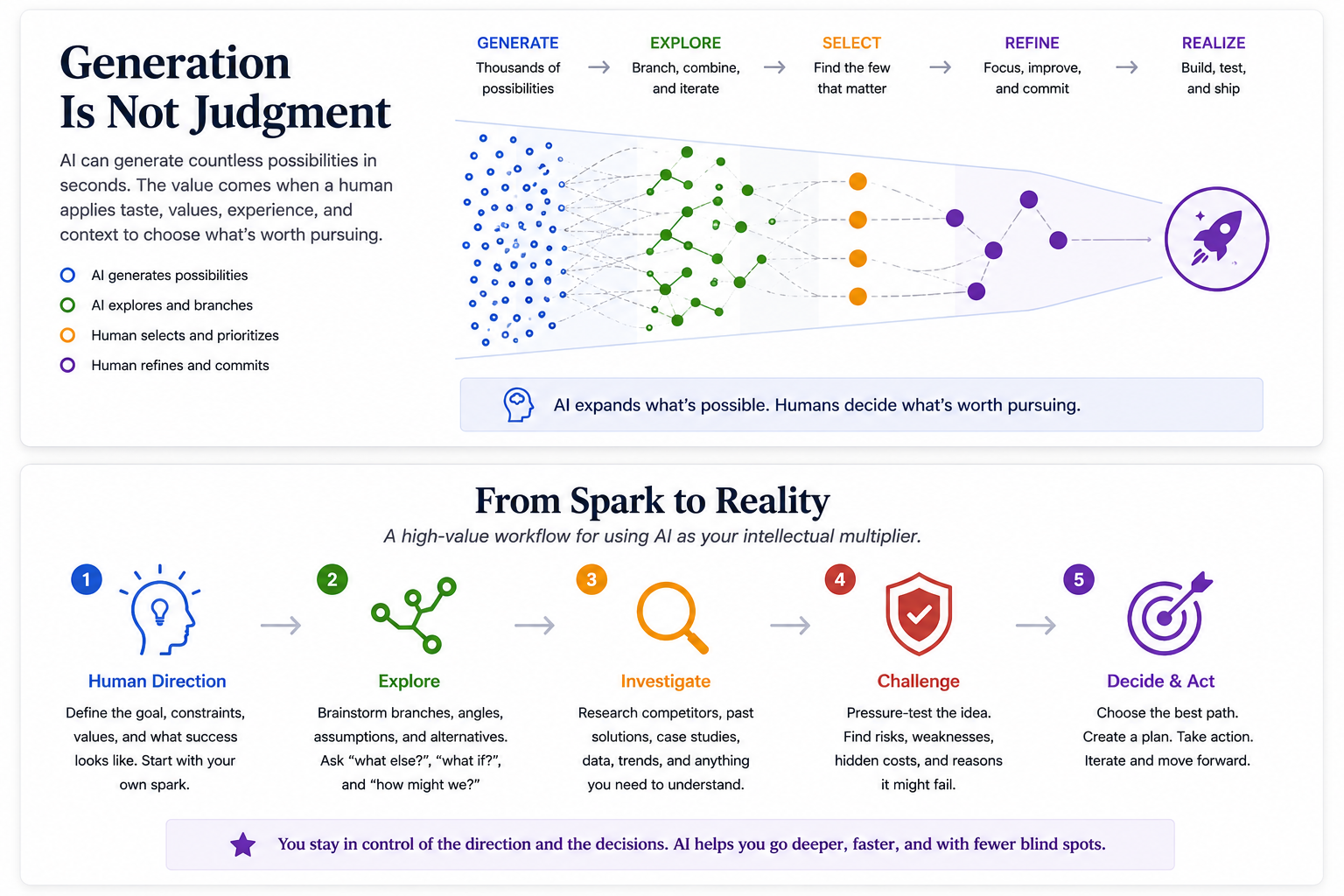
Generation is not judgment
One of the most useful studies here comes from scientific ideation. More than 100 natural-language-processing researchers participated in an experiment comparing expert-written research proposals with ideas generated by an LLM-based system.
The AI ideas were judged significantly more novel. They were also judged somewhat less feasible. More importantly, the researchers identified two weaknesses that matter far beyond academia: poor self-evaluation and weak diversity across generated ideas.3
That is close to the problem ordinary people run into when they ask AI what they should build.
The machine can produce options faster than you can. What it cannot give you for free is a trustworthy answer to questions such as: Which option fits my actual abilities? Which problem do I understand better than other people? Which tradeoff am I willing to live with? Which idea is merely impressive-sounding? Which one is boring but valuable? Which one will still matter after the novelty wears off?
AI is increasingly good at
- Producing many possible directions quickly
- Recombining concepts across domains
- Expanding a rough concept into branches
- Finding comparable work and prior attempts
- Identifying assumptions and missing pieces
You still need to own
- What problem is worth caring about
- Which tradeoffs are acceptable
- Whether the evidence changes your mind
- What fits your skills, resources, and values
- The decision to commit time, money, or reputation
That is why I do not think the best way to use AI is to sit in front of it empty-handed and demand inspiration.
You can do that. You may even get lucky. But you are assigning the machine the part of the process where your own experience, frustration, curiosity, taste, and judgment are most valuable.
AI can make everyone creative in the same direction
There is another problem with outsourcing the beginning.
Research on AI-assisted brainstorming has found a strange effect: people working with ChatGPT can produce ideas that evaluators consider more creative individually while the total collection of ideas becomes less diverse.4
In other words, AI may improve the average answer while nudging many people toward the same conceptual neighborhood.
That matters because innovation is not simply the production of polished possibilities. It also depends on exploring parts of the problem space that other people are ignoring.
If thousands of people ask similar systems similar questions, the danger is not necessarily that they all get bad answers.
The more interesting danger is that they all get reasonably good answers that rhyme with one another.
A human idea often begins somewhere inconvenient: a strange annoyance, a job you once had, something customers repeatedly struggled with, a contradiction you cannot stop thinking about, a tool you wish existed, or an experience that only becomes obvious after you have lived through it.
AI can help develop that observation.
But if you throw away the observation and ask the machine to supply the entire starting point, you may be exchanging your most differentiated input for a statistically plausible one.
The strongest counterexample is stronger than most people realize
There is now a serious answer to anyone who claims AI is incapable of real ideation.
Researchers behind AI Scientist-v2 built an agentic system capable of formulating hypotheses, writing code, executing experiments, analyzing results, creating figures, and writing complete machine-learning papers.
Three fully autonomous manuscripts were submitted to a peer-reviewed ICLR workshop. One received scores high enough to exceed the workshop's average human acceptance threshold.5
That is impressive.
It should be taken seriously.
It also demonstrates why generation and high-level judgment should not be treated as the same thing.
The system could perform enormous amounts of intellectual labor once it was operating inside a research direction. It could generate hypotheses, conduct experiments, analyze them, and produce the paper.
Could future systems automate those decisions too? Of course. Some systems are already attempting pieces of it.
But “AI may eventually do this” is different from “you should surrender that judgment now.”
This is where AI becomes genuinely powerful
Suppose you already have something.
Not a business plan. Not a finished thesis. Not a complete product specification.
Just a direction.
Maybe you noticed that a process at work is absurdly inefficient. Maybe you have a story premise that feels interesting but thin. Maybe you think an existing app solves the right problem badly. Maybe you have a question that does not seem to have a satisfying answer. Maybe you can picture a product but have no idea how to build it.
Now AI has something to work against.
Use it to branch
A rough idea usually hides several different ideas inside it. AI is very good at separating them.
It can expose alternate audiences, different implementations, competing assumptions, simpler versions, stranger versions, and adjacent problems.
You do not have to accept any of them. The value is seeing a larger map than the one in your head.
Use it to investigate
You can arrive with a concept and very little domain knowledge.
AI can help you identify what you need to learn, discover terminology you did not know existed, locate previous attempts, compare approaches, summarize documentation, and identify questions you did not yet know how to ask.
This is one of the most underrated uses of the technology.
The distance between “I have an idea” and “I understand enough to decide whether this deserves further work” can shrink dramatically.
Use it to challenge you
An idea becomes more useful when it survives resistance.
Use AI to surface assumptions, edge cases, failure modes, conflicting evidence, hidden costs, and people the idea may not serve well.
Then verify the important claims.
AI is not a substitute for evidence, but it can be very good at showing you where evidence is needed.
Use it to compare
You do not need to pretend competitors do not exist.
Study them.
Find out what they built, what users praise, what users complain about, which compromises appear repeatedly across the market, and which problems nobody seems to have solved cleanly.
The goal is not to ask AI, “How do I copy this?”
The better question is: What has the market already taught us?
A competitor's bad review can reveal a user expectation. Several competitors failing in the same way can reveal a structural opportunity. A feature appearing everywhere may tell you it is no longer differentiation at all. It may simply be the price of admission.
Learn from competitors without becoming your competitors
There is an important legal and ethical boundary here.
In the United States, copyright generally does not protect an idea, procedure, process, system, concept, principle, or method itself. Copyright can protect the original expression used to communicate or implement those ideas.6
That means studying how other people approached a problem is not the same thing as copying their written content, artwork, code, screenshots, photographs, or other protected expression.
But “ideas are not copyrighted” is not a universal permission slip.
Patents, trademarks, trade secrets, contracts, and other legal rights can raise separate questions depending on what you are building and how you obtained the information.
So use AI to compare. Use it to research. Use it to identify similarities and differences. Use it to help you understand the landscape.
Then build something that reflects your own choices rather than a thinly disguised copy of somebody else's execution.
This section provides general educational information, not legal advice. When intellectual-property clearance matters to an actual launch, investment, or commercial decision, obtain qualified legal guidance.
Good prompting is not a magic sentence
There is an entire internet genre built around “the perfect AI prompt.”
Some of it is useful.
Some of it resembles spellcasting.
The more durable lesson is simpler: AI becomes more useful when it understands what you are actually trying to accomplish, what constraints matter, what context you already possess, and how you intend to judge the result.
You do not need a sacred string of words.
You need a productive conversation.
That means being willing to say: No, that is not what I meant. That assumption is wrong. These three options are too similar. Compare this with what already exists. What evidence supports that? What am I overlooking? Try another direction.
The power is not in discovering the incantation that makes AI brilliant.
The power is in becoming good at steering, correcting, interrogating, and deciding.
What are you actually asking AI to do?
Before asking for another list of ideas, decide which role you actually need.
The distinction changes the conversation.
Choose the role
This will not give you a copy-and-paste prompt. It will give you questions worth thinking about.
Start with the role, not the wording.
Choose one of the four options above. Decide what kind of thinking you want help with before deciding what to type.
The advantage will belong to people who still bring something
AI will get better.
The line between generation, evaluation, and autonomous execution will continue to move.
I do not think it is useful to build an argument around the permanent claim that machines can never be creative. Evidence is already making that position difficult to defend.
But there is a more immediate question than whether AI will someday originate most of humanity's important ideas.
What should you do with the tool you have now?
Bring it an observation.
A frustration.
A half-built concept.
A question.
A contradiction.
Something you want to understand.
Something you suspect could be better.
Then make the machine work.
Make it branch the idea until you can see alternatives. Make it investigate what came before. Make it compare implementations. Make it explain the parts you do not understand. Make it attack your assumptions. Make it show you the questions you have not answered. Make it help you turn curiosity into something testable.
And then do the part that still matters most: decide.
That is a less magical promise than “ask AI for your next great idea.”
It is also much more useful.
If you disagree, the most interesting question is not whether AI can be creative. We already have evidence that it can.
The better debate is this: At what point does generating, evaluating, selecting, and pursuing an idea become something we are comfortable handing over completely?
Sources
- Wang, D., Huang, D., Shen, H. et al. “A large-scale comparison of divergent creativity in humans and large language models.” Nature Human Behaviour, 2026. Read the study .
- Bellemare-Pepin, A. et al. “Divergent creativity in humans and large language models.” Scientific Reports, 2026. Read the study .
- Si, C., Yang, D., Hashimoto, T. “Can LLMs Generate Novel Research Ideas? A Large-Scale Human Study with 100+ NLP Researchers.” Read the paper .
- Meincke, L., Nave, G., Terwiesch, C. “ChatGPT decreases idea diversity in brainstorming.” Nature Human Behaviour. Read the study .
- Yamada, Y. et al. “The AI Scientist-v2: Workshop-Level Automated Scientific Discovery via Agentic Tree Search.” Read the paper .
- U.S. Copyright Office. Copyright protection does not extend to ideas, processes, systems, methods of operation, concepts, principles, or discoveries, though original expression may be protected. Copyright Office guidance .
AI content disclosure: A Wandering Mind used AI-assisted research, drafting, and visual development as part of the editorial process for this article. The argument, research direction, source selection, revisions, and publication decision were human-directed. Readers should evaluate factual claims against the linked primary sources.
Share this article
Found this useful? Share it with someone else.