
A Tree Is Made From Air: Where Plants Actually Get Their Mass
Plants are made from air
Most of a plant's dry mass does not come from a disappearing pile of dirt. It comes from carbon dioxide in the atmosphere, water taken up by the roots, and the chemistry powered by sunlight.
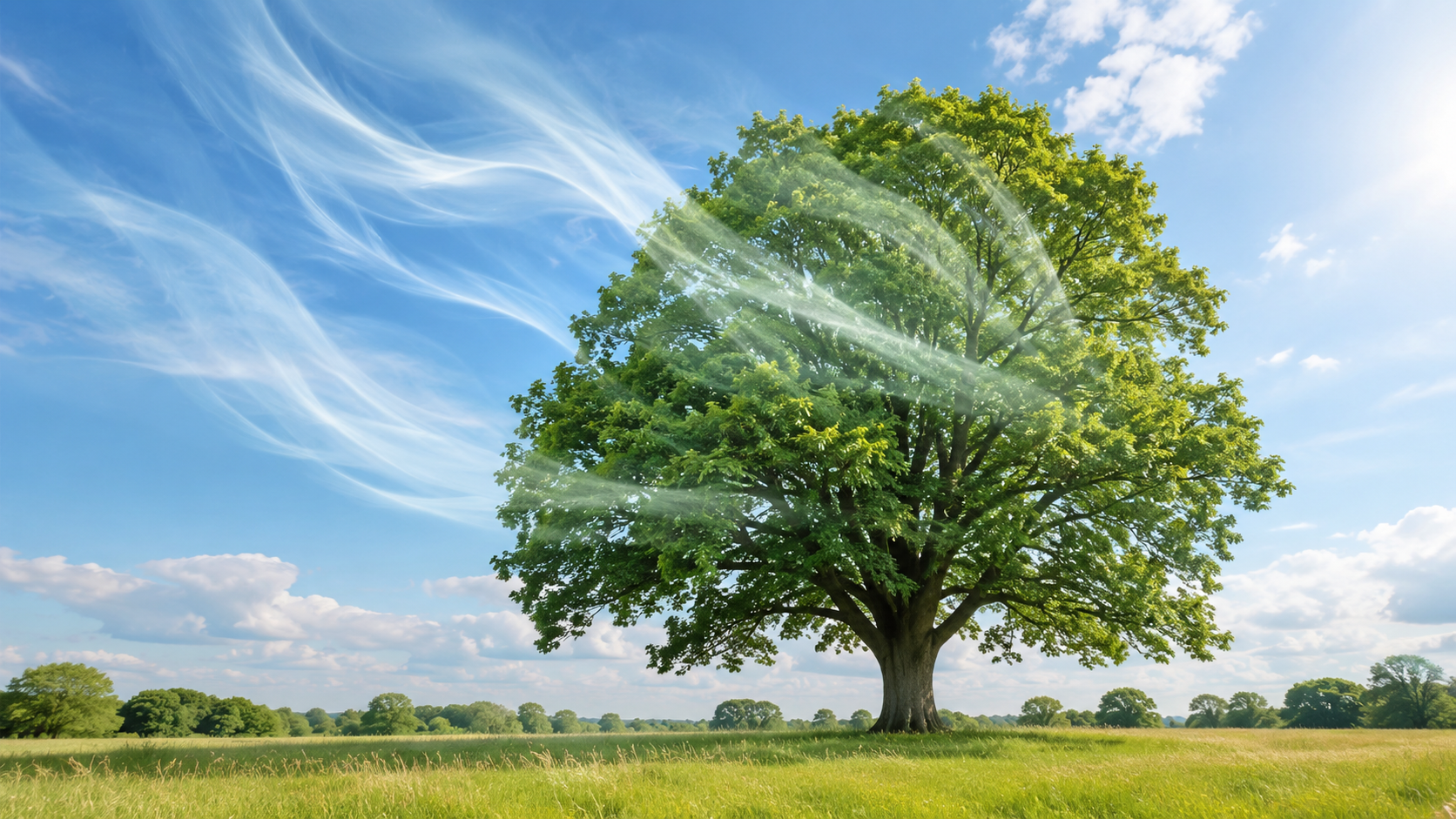
A tree is, in a very real sense, atmosphere turned into living matter by sunlight.
Look at a tree and the obvious answer seems wrong
Roots are buried in soil, the trunk gets thicker, the canopy gets bigger, and the intuitive conclusion is that the plant must be turning dirt into wood. That is not where most of the mass comes from.
A large fraction of the solid material in a plant began as an invisible gas. Carbon dioxide enters a leaf from the atmosphere, its carbon is incorporated into organic molecules, and those molecules become sugars, cellulose, roots, bark, fruit and new leaves.
Water supplies additional atoms. Soil supplies essential nutrients. Sunlight provides the energy that drives the chemistry. But if you dry a plant and ask where the bulk of that dry matter came from, the answer is the air and water—not a disappearing mound of soil.
Plants build most of their dry mass from carbon, hydrogen and oxygen. Carbon enters mainly as atmospheric CO2; hydrogen comes largely from water; oxygen in plant molecules comes from both CO2 and water. Soil minerals are necessary, but by mass they make up only a small share of plant dry matter.
As an Amazon Associate I earn from qualifying purchases.
The five-year experiment that made the soil look suspicious
In the 1600s, the Flemish physician and chemist Jan Baptista van Helmont performed one of the most famous early plant-growth experiments. He dried a large amount of soil, weighed it, planted a small willow shoot, and watered the plant for five years.
Van Helmont concluded that the added mass came from water. That explanation was incomplete, because he did not yet know about carbon dioxide entering from the air or the modern mechanism of photosynthesis.
But he still uncovered the key clue: the huge increase in plant mass could not be matched by a huge loss of soil. The dirt was not being converted pound-for-pound into the tree.

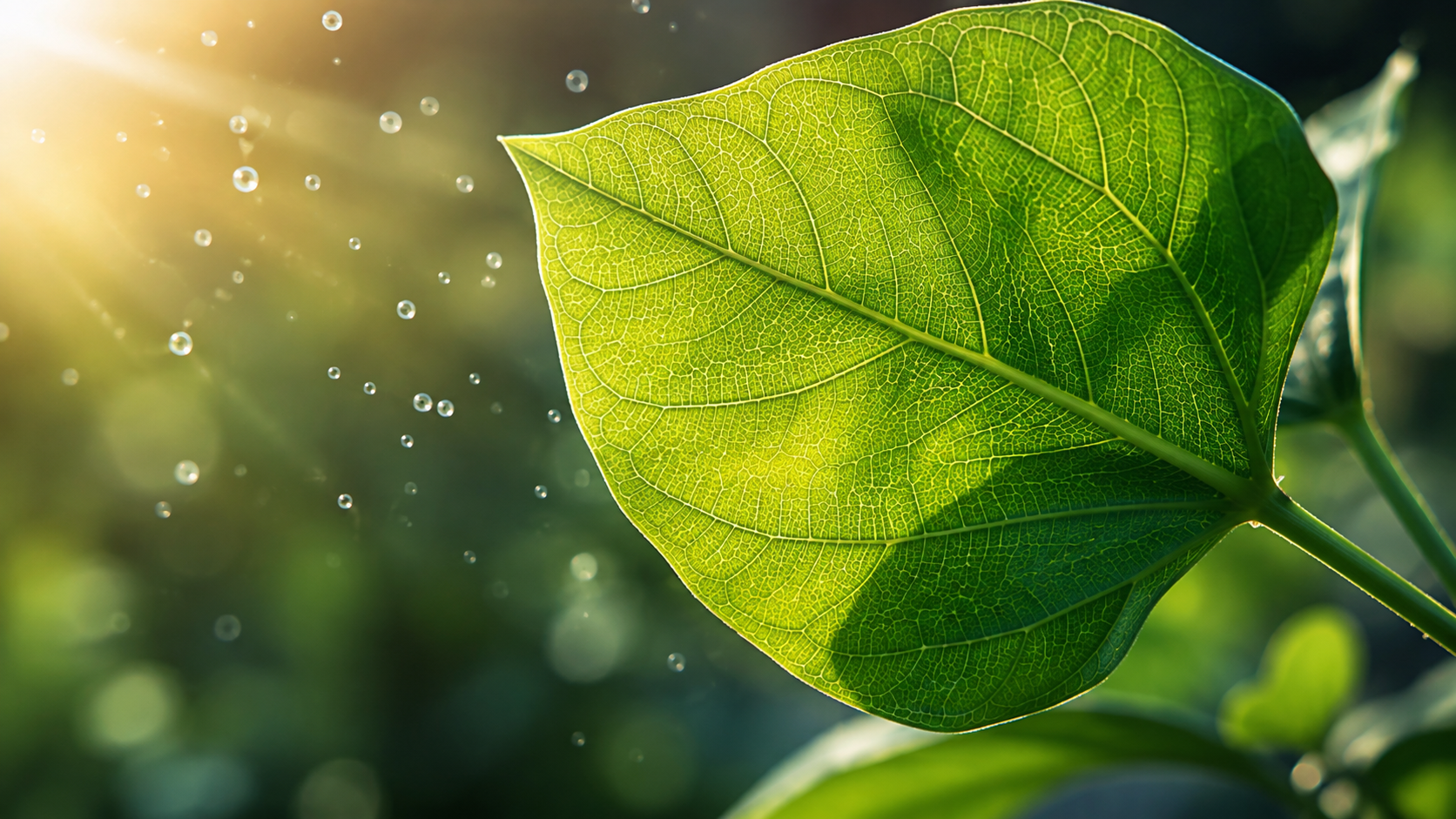
So what is a plant actually made of?
Remove the water from plant tissue and look at the remaining dry matter. Biology and agricultural references commonly put carbon, hydrogen and oxygen at roughly 95–96% of that dry mass, although exact values vary by species and tissue. Carbon alone is often around 45% of dry plant matter.
This is why saying “plants are made from air” is memorable but incomplete on its own. The carbon really does come from the atmosphere, but plants are not made from carbon dioxide alone. Water contributes hydrogen and oxygen, while soil provides the mineral elements the plant needs to keep the machinery running.
Sunlight is the power source, not the raw material
Photosynthesis does not turn light into matter. Light provides energy. The atoms that become plant tissue already exist in carbon dioxide, water and nutrients. Photosynthesis rearranges those atoms into energy-rich organic molecules.
How does invisible gas become a solid tree?
Carbon dioxide enters leaves through microscopic pores called stomata. Inside photosynthetic cells, carbon is fixed into organic molecules. The plant can then turn those carbon-containing molecules into structure, stored energy and the rest of the living organism.
Immediate products and transportable forms of stored chemical energy.
A way to store carbohydrate for later use.
A structural carbohydrate that becomes a major part of plant cell walls.
With additional elements such as nitrogen and phosphorus, captured carbon also contributes to proteins, lipids, DNA and the rest of the living plant.
That is the mental image worth keeping: carbon atoms drifting in the atmosphere can enter a leaf, become part of a sugar, and eventually end up locked into the trunk of a tree you can touch with your hand.
The oxygen released by photosynthesis comes from water
This is one of the most surprising details hidden inside the familiar schoolbook equation. The oxygen gas released by oxygenic photosynthesis is produced when water is oxidized in photosystem II. In other words, the O2 leaving the leaf is not simply the two oxygen atoms from a carbon dioxide molecule being discarded together.
Experiments using oxygen isotopes helped establish the water origin of photosynthetic oxygen. That detail matters because oxygenic photosynthesis by plants, algae and cyanobacteria is ultimately responsible for Earth having an oxygen-rich atmosphere.
Plants also use oxygen
Plants are not one-way oxygen machines. Their cells also perform cellular respiration, consuming oxygen as they release usable energy from organic molecules. What changes the atmosphere is the overall balance: photosynthesis can produce more oxygen than the organisms immediately consume.
If the mass is not mostly soil, why do plants need soil?
Because “small by mass” and “unimportant” are completely different ideas. A car battery is a small fraction of a car's mass, but the car is not going anywhere without it. Plants have the same kind of dependency on mineral nutrients.
Needed for amino acids, proteins, nucleic acids and chlorophyll-related metabolism.
Important in ATP, nucleic acids and energy transfer.
Helps regulate water balance, enzymes and stomatal function.
Magnesium sits at the center of chlorophyll, while many other elements support enzymes, membranes and growth.
Roots also anchor the plant, absorb water and interact with complex communities of fungi and microorganisms. Soil is critically important. The claim here is narrower: it is not the bulk source of the carbon skeleton that becomes wood.

That connects the air around you to the food inside you
Plants are primary producers. They capture light energy and store some of it in chemical bonds. Animals can obtain that stored energy by eating plants, and other animals can obtain it by eating those animals. Humans plug into the same network.
For almost every calorie in an ordinary human diet, follow the chain backward far enough and you reach photosynthesis: a photosynthetic organism captured light energy and fixed carbon into organic matter. There are unusual ecosystems powered by chemosynthesis rather than sunlight, but they are the exception—not the basis of normal human agriculture and food production.
If plants can turn atmospheric carbon into food, then how does that captured solar energy eventually become the calories that power your body? That is where photosynthesis meets cellular respiration—and where this story goes next.
Quick questions about plant mass and photosynthesis
Do plants get any of their mass from soil?
Yes. Plants absorb mineral elements from soil or another growing medium, and those elements become part of plant tissue. The key point is that minerals account for a relatively small share of dry plant mass compared with carbon, hydrogen and oxygen.
Does sunlight itself become plant matter?
No. Sunlight supplies energy rather than atoms. The physical matter comes from substances such as carbon dioxide, water and mineral nutrients. Light energy powers the reactions that rearrange those atoms.
Was van Helmont right that the willow came from water?
Only partly. His experiment helped demonstrate that the new mass was not coming mainly from disappearing soil, but he did not account for carbon dioxide from the atmosphere. Modern photosynthesis research explains the major role of atmospheric carbon.
Where does the oxygen released by plants come from?
The molecular oxygen released during oxygenic photosynthesis is generated from water during the light reactions in photosystem II.
Sources and further reading
- NASA Science — The Carbon Cycle. Overview of photosynthesis as a major pathway moving carbon from atmospheric CO2 into biological molecules.
- OpenStax Biology 2e — Nutritional Requirements of Plants. Plant elemental composition and the roles of carbon, hydrogen, oxygen and mineral nutrients.
- Alabama Cooperative Extension — Essential Plant Nutrients. Discussion of carbon, hydrogen and oxygen as the dominant elements in plant dry weight.
- Yale National Initiative — curriculum history of photosynthesis. Historical context for Jan Baptista van Helmont and the willow experiment.
- Barber, J. — Photosynthetic generation of oxygen. Review of photosystem II and the oxidation of water that produces atmospheric oxygen.
- Photosynthesis: basics, history and modelling. Historical and mechanistic overview, including isotope evidence supporting water as the source of photosynthetic O2.
Editorial note: This article was prepared with AI-assisted research and drafting and reviewed against the cited scientific sources before publication. A Wandering Mind is a Kestrel Ventures LLC property.