
How to Make a Solar System Model That’s Actually to Scale

That is not necessarily a problem. The important part is knowing what your model is simplifying. Use the calculator below to build a solar system that fits a desk, classroom, hallway, playground or football field—and see what a truly to-scale model would actually require.
Can a school solar system model really be to scale?
Yes—but usually not in the way people expect. You can accurately scale the planet sizes, accurately scale the distances, or scale both at once. The third option gets surprisingly large very quickly.
NASA's Jet Propulsion Laboratory explicitly warns that the enormous gaps between planets make it difficult—and sometimes impossible—to show both planet size and distance accurately on an ordinary page, screen or classroom display.
That is why this guide gives you three good models instead of pretending one craft can do everything: a size model, a distance model, and a true combined scale for people with enough room.
Scale My Solar System
Tell the calculator how much room you have—or how big you want the Sun to be. It will calculate the planet positions and the sizes required by the same scale.
| World | Average real distance | Model distance | Real diameter | Model diameter |
|---|
Uses average orbital distances and NASA equatorial planet diameters. Orbits are elliptical, so real planet-to-Sun distances vary over time. The distance model is radial: it compares average distance from the Sun, not the planets' current orbital positions.
The empty space is the point.
Many textbook illustrations make the solar system look crowded because there is no practical way to put billions of kilometers of empty space on a page. Scale models correct that intuition.
NASA's education materials use exactly this kind of activity because students often underestimate the distances between planets. JPL's Solar System Scroll activity even calls the amount of empty space one of the most persistent misconceptions among students and adults.
On NASA's football-field comparison, Jupiter is only around the thickness of a U.S. quarter while the outer planets sit tens of yards from the Sun. A combined size-and-distance model forces you to confront just how tiny the planets are compared with the space between them.
Three good solar system models
“Accurate” depends on what your model is trying to teach. Pick one goal and label it honestly rather than mixing several different scales without explaining them.
Planet-size model
Best for: desks, dioramas and visual planet comparisons.
- Keep planet diameters proportional.
- Do not pretend the gaps are to scale.
- Works well with foam balls or clay.
Distance model
Best for: hallways, playgrounds and outdoor lessons.
- Place markers at proportional distances.
- Use beads, pins or labels for planets.
- Planet marker sizes can be symbolic.
One true scale
Best for: the most scientifically honest “wow” moment.
- Size and distance use the same scale.
- Planets become surprisingly tiny.
- Often requires a field or long outdoor route.
What to use for your model
Match the material to the type of scale model. Foam balls are excellent for a size-focused display. For a distance-accurate model, small beads, pins, sidewalk chalk or labeled cards are usually more honest because the planets become extremely small at classroom scales.
What each planet should look like
A school model does not need museum-level surface painting, but the planets should be recognizable. Use NASA imagery as your reference and focus on the features that distinguish one world from another. If you are making a size model, keep the ball diameters proportional before you start painting.
Small, gray and cratered
Mercury is the smallest planet, with an equatorial diameter of about 4,880 km. Use gray with lighter and darker patches. It should be only about 38% of Earth's diameter in a size model.
Pale cream and yellow-white
Venus is almost Earth's size—about 12,104 km across—but its thick cloud deck hides the surface in visible-light images. Cream, pale yellow and soft tan work better than painting a fiery orange bare surface.
Blue, white, green and brown
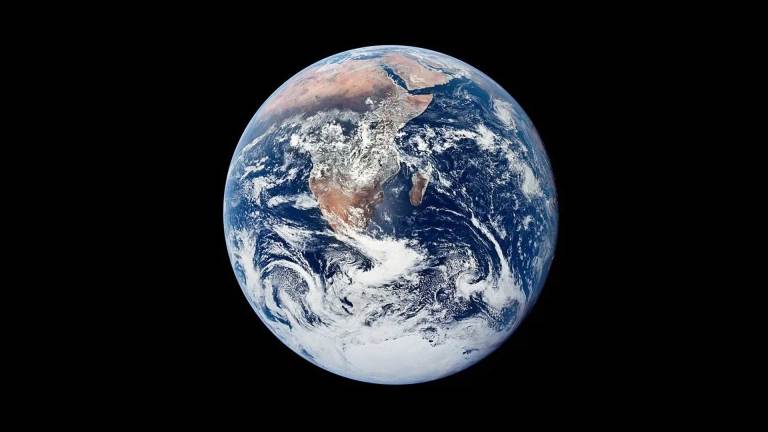
Earth is about 12,756 km across at the equator. Blue oceans should dominate, with irregular land shapes and thin white cloud patterns. Avoid making continents perfectly geometric—the irregularity makes the model more convincing.
Rust red with darker terrain
Mars is about 6,792 km across, a little over half Earth's diameter. Start with a muted rust or orange-red base and add darker brown areas. Small white polar caps are a useful finishing detail.
Huge, striped and stormy
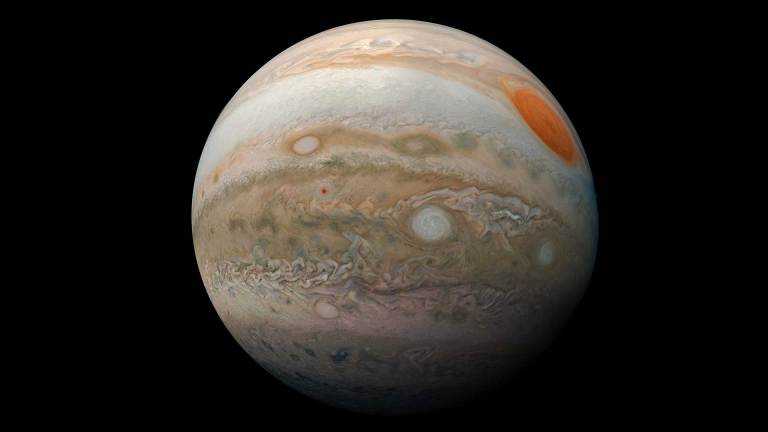
Jupiter is the largest planet at about 142,984 km across—roughly 11 times Earth's diameter. Use cream, tan, brown and muted orange bands. A small reddish oval can represent the Great Red Spot.
Pale gold with unmistakable rings
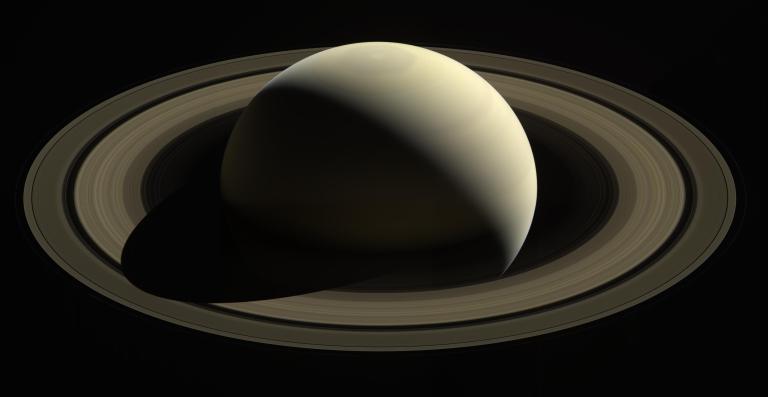
Saturn is about 120,536 km across, excluding its rings. Paint the globe pale yellow, cream and tan. A thin cardboard or craft-foam ring is visually effective, but note that most classroom ring systems will not be accurately scaled.
Pale cyan
Uranus is about 51,118 km across. A nearly uniform pale blue-green or cyan is a good classroom representation. Its rings are faint, so leaving them off a simple model is more defensible than drawing giant dark rings.
Deep blue
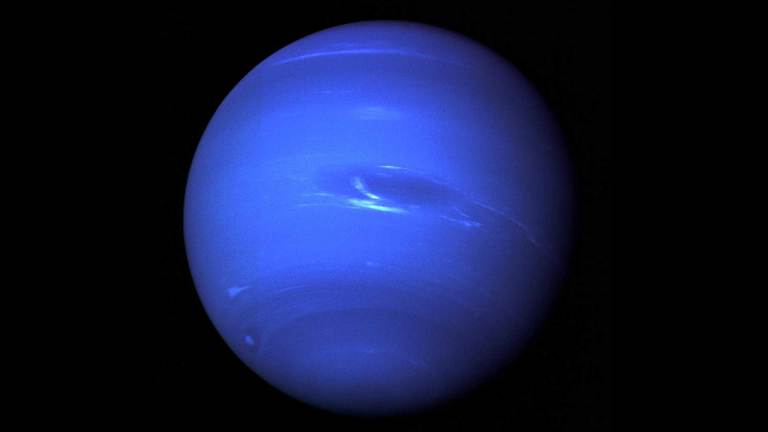
Neptune is about 49,528 km across, slightly smaller than Uranus. Use a richer blue than Uranus, with subtle darker or lighter bands if desired. In a distance model, Neptune is the endpoint used by our calculator.
How to make your solar system model
Decide what “to scale” means for your project
Choose size, distance, or one shared scale for both. Put that choice on your project label. A model that says “planet sizes are proportional; distances are not” is more scientifically useful than a prettier model that quietly mixes scales.
Measure your available space
For a distance model, measure from the model Sun to the farthest point you can use. That becomes Neptune's position in the calculator. NASA/JPL recommends determining your available space first and choosing the scale from that constraint.
Run the scale calculator
Enter your available distance and copy or print the results. If the resulting planet diameters are smaller than anything you can reasonably craft, use labeled markers instead. That is not cheating—it is the scientific lesson.
Build and label the Sun first
The Sun is the reference point for every distance. Mark its center clearly. If you are doing a size model, remember that the Sun is vastly larger than any planet and may be too large to fit alongside them.
Place planets in order
From the Sun outward: Mercury, Venus, Earth, Mars, Jupiter, Saturn, Uranus, Neptune. Mark each measured distance from the Sun—not from the previous planet—so small measuring errors do not accumulate.
Add a scale key
Include the rule you used, such as “Neptune = 25 feet from the Sun” or “model Sun diameter = 30 cm.” If planet markers are symbolic rather than size-accurate, say so directly.
Four worlds, four very different scales
The planet images below are presented for identification—not at a common scale. The calculator is where the actual numerical scale lives.
Five mistakes that are easy to fix
Spacing every planet evenly
The outer solar system is dramatically more spread out than the inner planets. Equal gaps erase the most surprising part of the scale.
Making every planet roughly the same size
Jupiter is about 11 times wider than Earth, while Mercury is a little over one-third Earth's width. A size model should make those differences obvious.
Making the Sun only slightly larger than Jupiter
A tabletop project often has to shrink the Sun disproportionately just to fit. That is fine if you disclose it. Do not label that part “to scale.”
Showing the planets permanently in one straight line
A line is a convenient distance diagram. Real planets orbit around the Sun and are usually spread around different parts of their orbits.
Calling Pluto the ninth planet without explanation
The solar system has eight planets. Pluto is one of five officially recognized dwarf planets. You can absolutely include it—just label it correctly.
Explain the limitation
A model becomes more educational when the student can explain why a compromise was necessary. The limitation is part of the science.
The scale is just one ratio used everywhere.
A scale model works when every distance and every size is multiplied by the same conversion factor. If Neptune's average 4.5-billion-kilometer orbital distance becomes 25 feet in your model, the calculator applies that exact same ratio to Earth's 149.7-million-kilometer distance and to every planet diameter.
That is also why a true combined model can feel ridiculous. The mathematics is not failing—the model is exposing reality. The solar system is not a collection of large balls sitting close together. It is a collection of comparatively tiny worlds separated by enormous distances.
NASA/JPL's classroom activities use scale models to teach ratios, proportional reasoning, astronomical units and the difference between a diagram and a physical system. The same project can therefore serve as both a science lesson and a math project.
You can include Pluto. Just call it a dwarf planet.
NASA lists eight planets and five officially recognized dwarf planets. Pluto's average orbital distance is about 5.9 billion kilometers—farther than Neptune's 4.5 billion kilometers—so adding Pluto makes a distance model significantly longer.
If your assignment specifically asks for “the planets,” stop at Neptune. If the goal is to show the broader solar system, adding Pluto and other dwarf planets can make the project more interesting.
Solar system model questions
What is the correct order of the planets?
From the Sun outward: Mercury, Venus, Earth, Mars, Jupiter, Saturn, Uranus and Neptune.
How do I make a solar system model to scale?
Choose one scale ratio and apply it consistently. You can scale planet sizes, planet distances, or both. If you want both sizes and distances accurate, use the same conversion factor for every measurement.
Why are most solar system models not truly to scale?
Because the planets are extremely small compared with the distances between them. A model that fits on a desk usually has to exaggerate planet sizes, compress distances, or both.
What size should Earth be in a model?
There is no single correct craft size. Earth's model diameter depends entirely on the scale you choose. Use the calculator above to generate the correct diameter for your chosen distance or Sun size.
Should Pluto be included?
The solar system has eight planets, so Pluto is not included when an assignment asks only for planets. Pluto can still be included as a dwarf planet.
Are the planets ever lined up in a straight line?
Not in the simple permanent arrangement shown by many classroom diagrams. The planets orbit the Sun at different speeds and positions. A straight-line scale model is mainly a way to compare average radial distances.
What materials are best for a school solar system project?
Foam balls and paint work well for a size-focused display. Beads, string, chalk, flags or labeled cards are better for a distance model because the correctly scaled planet diameters quickly become tiny.
Can I make a solar system model on a football field?
Yes. Large outdoor spaces are ideal for distance models because they make the enormous gaps between the planets easier to experience physically.
NASA sources used for this guide
- NASA/JPL Education — Make a Scale Solar System . Classroom project for calculating planet sizes, relative distances, or both.
- NASA Science — Planet Sizes and Locations in Our Solar System . Planet diameters and average orbital distances used in the calculator.
- NASA Science — How Big Is the Solar System? . Football-field scale examples.
- NASA/JPL Education — Solar System Scroll . Lesson on misconceptions about planetary spacing.
- NASA/JPL Education — Solar System Bead Activity . Distance model using beads and string.
Published by A Wandering Mind. This page uses average orbital distances for educational modeling. Planet distances from the Sun vary because planetary orbits are elliptical. NASA imagery is credited where displayed.