
Why Is It Called Lake Ontario? The Indigenous Name Behind the Great Lake
The name Ontario is older than the Canadian province, older than the United States, and older than Canada itself. Its roots are Indigenous and Iroquoian, but the exact English translation is not as simple as many quick explanations make it sound.
Lake Ontario gets its name from an Indigenous Iroquoian word or closely related family of words associated with the lake and its waters. Credible sources translate surviving forms as “sparkling water,” “beautiful lake,” “great lake,” or “lake of shining waters.” The wording varies because related Indigenous languages, early European spellings, and centuries of translation do not map neatly onto one modern English phrase.
01 · The name came before the modern border
Where does the name Lake Ontario come from?
“Ontario” did not begin as the name of a Canadian province. The word was already being recorded in connection with the eastern Great Lakes in the seventeenth century, more than two hundred years before Ontario became a province in 1867.
The strongest historical point is also the simplest: Ontario is an Indigenous-derived name. Canadian federal sources trace the word to an Iroquoian form written as kanadario, translated as “sparkling” water. An Ontario government source gives the related Mohawk form Oniatari':io, translated as “beautiful lake.” Contemporary reporting about the lake’s Wendat roots has also used the form oniatarí:io, rendered as “lake of shining waters.”127
Those differences are not a reason to dismiss the Indigenous origin. They are a reason to be careful about pretending that one modern English phrase can perfectly reconstruct a word that moved through related Indigenous languages and then through French and English spelling systems.
This also explains why older sources can appear inconsistent. Europeans who wrote down Indigenous place names were trying to represent sounds that did not necessarily fit French or English spelling conventions. Different writers encountered different speakers, heard related forms, and made different choices about how to spell them. Over time, one spelling—Ontario—became dominant.
02 · Translation is the messy part
Does Ontario mean “beautiful lake,” “great lake,” or “sparkling water”?
Depending on the source, you may encounter all three—and sometimes “beautiful water” or “lake of shining waters” as well. A good history of the name should not hide that disagreement.
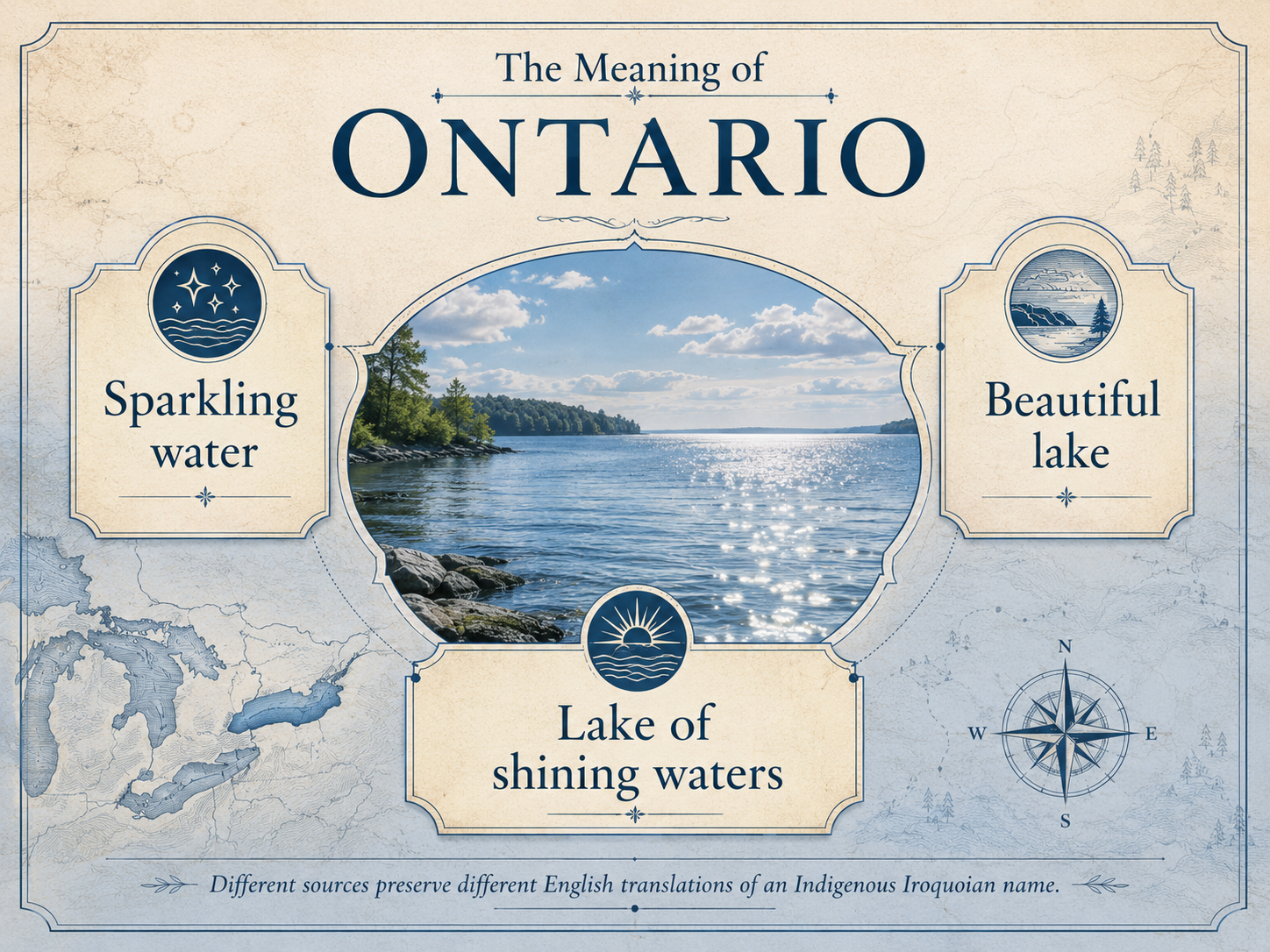
Natural Resources Canada and Canadian Heritage connect Ontario with the Iroquoian form kanadario and translate it as “sparkling” water.
An Ontario government release identifies a Mohawk form, Oniatari':io, and gives the meaning “beautiful lake.”
Recent reporting on the lake’s Indigenous history gives the Huron/Wendat-linked form oniatarí:io and renders it as “lake of shining waters.”
Historical place-name scholarship has also associated related forms with the idea of a large, great or beautiful lake.
There are several reasons for the variation. First, Wendat, Mohawk, Seneca and other Iroquoian languages are related but not identical. A related place-name form can survive differently in different communities. Second, seventeenth-century French writers did not have a standardized English-style spelling for the sounds they heard. Third, translation is interpretation: a word connected with a beautiful, shining or impressive body of water may not have a single one-to-one English equivalent.
That is why this article does not choose one translation simply because it sounds the most poetic. The evidence supports a stronger conclusion than any single gloss: the name belongs to the Indigenous linguistic history of the Great Lakes.
03 · Ontario was not the only name on the map
What Europeans called the lake before “Ontario” won
European explorers, missionaries and mapmakers tried several names for the lake. Some honored French royalty or colonial officials. Others described the Indigenous peoples associated with the region. For decades, multiple names existed at the same time.
Historian Ivan H. Walton’s study Origin of Names on the Great Lakes traces that competition through early maps and Jesuit records. Walton notes that Samuel de Champlain labeled the lake Lac S. Louis in 1632. In 1635, Jesuit missionary Jean de Brébeuf referred to it as the Lake of the Hiroquois—an older spelling of Iroquois. Walton then identifies the name Ontario in European records around 1639–1641.3
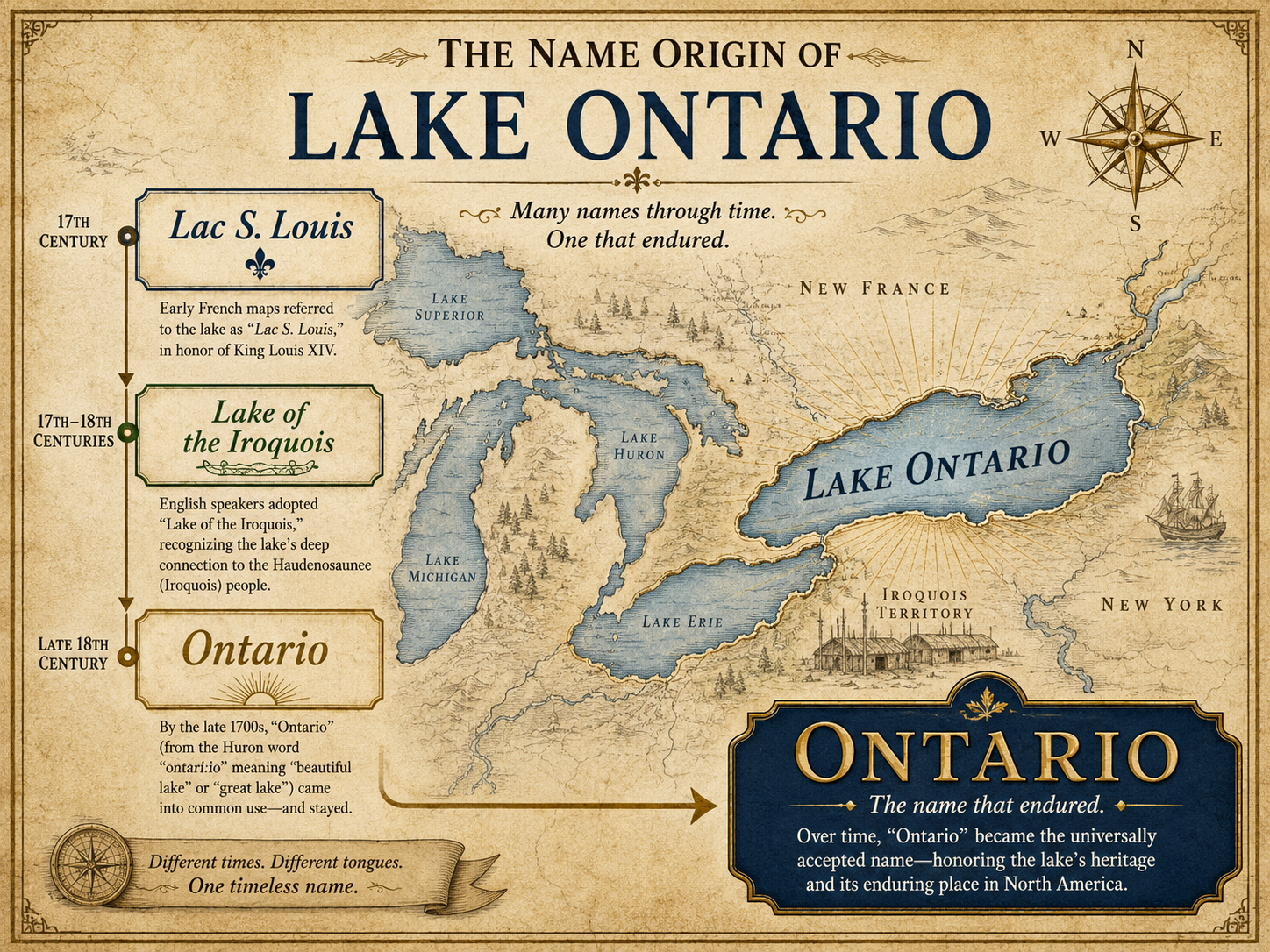
Champlain uses a French royal name for the lake.
Brébeuf describes the lake by the people associated with the region.
Walton reports that Johannes de Laet used Ontario two years before Lalemant’s 1641 reference.
Jérôme Lalemant uses the present name while also retaining the French alternative.
Paul Ragueneau distinguishes the Indigenous-derived name from the French Saint Louis name.
Simon Le Moyne uses Ontario without needing to explain the French alternative.
Jesuit historian Francis Creuxius uses a Latinized form of Ontario.4
Maps preserve combinations such as Frontenac, Ontario, Skaniadorio and St. Louis.
The already-established regional name is adopted for the new province at Confederation.1
A U.S. executive order directs federal agencies to replace Lake Ontario with Lake America in federal geographic usage.5
One late-seventeenth-century map gathered several of the competing labels into a single name: Lac Frontenac ou Ontario et Skaniadorio ou St. Louis. In other words, even European mapmakers were documenting a period when the lake’s identity had not yet settled into one standardized label.
Eventually, the Indigenous-derived name outlasted the colonial alternatives. Saint Louis faded. Frontenac faded. Ontario remained.
04 · The chronology is backwards from what many people assume
Was Lake Ontario named after the Province of Ontario?
No. The word Ontario was in use centuries before the modern Province of Ontario existed.
Canadian federal sources say that by 1641 the name Ontario was being used for land along the north shore of the eastern Great Lakes. The political geography changed repeatedly after that. Under British rule, much of what is now southern Ontario became known as Upper Canada. In 1867, when Confederation created the modern province, the name Ontario was adopted for it.1
So the safest way to state the relationship is this: the province did not give the lake its name. Ontario was already an established geographic and regional name, rooted in Indigenous language, long before it became the official name of a Canadian province.
05 · A four-century-old name meets a modern political decision
What changed when the United States renamed it “Lake America”?
On August 27, 2026, President Donald Trump signed an executive order titled Honoring the American History of the Great Lakes and Renaming Lake Ontario as Lake America. The order directs the U.S. Secretary of the Interior and the Board on Geographic Names to adopt Lake America for U.S. federal geographic usage, update the Geographic Names Information System, and use the new name in federal maps, contracts, documents and communications.5
That is a real change in U.S. federal naming policy. It is not the same thing as changing what Canada calls the lake, and it does not alter the historical origin of the word Ontario.
The practical result is already visible online. The Associated Press reported that Google Maps began showing Lake America to users in the United States, Lake Ontario to users in Canada, and both names to some users elsewhere, following Google’s policy of reflecting official geographic names by country.6
Indigenous leaders have objected to the U.S. renaming and emphasized that Ontario’s name predates both modern countries. The Seneca Nation, for example, called for the order to be reversed and highlighted the lake’s Indigenous naming heritage. Recent reporting has also cited the Seneca name sga:nyodai:yoh, translated as “beautiful lake,” alongside the Huron/Wendat-linked oniatarí:io.7
Whether “Lake America” lasts in U.S. federal records is now a question of politics and future policy. The history behind Ontario is a different question—and one that reaches much farther back.
06 · What survived
A name older than the countries around it
Modern maps make political borders look permanent. They are not.
When Europeans began recording versions of the name Ontario in the seventeenth century, neither the United States nor Canada existed as modern countries. The lake sat within a much older Indigenous world of nations, languages, trade routes and territories.
European powers attempted to layer their own names onto the water. A French king gave the lake Saint Louis. A colonial governor gave rise to Frontenac. Missionaries and cartographers used still other labels.
Those names did not become the one most people inherited.
Ontario survived because Indigenous geography was not simply erased when European mapmakers arrived. In this case, part of it remained embedded in the map.
The exact translation may never fit perfectly into one English phrase. But the larger history is unusually clear: the word Ontario came from Indigenous language, passed through centuries of European transcription, and became one of the most recognizable geographic names in North America.
07 · Frequently asked questions
Lake Ontario name origin: quick answers
What does Ontario mean?
There is no single English translation that every credible source uses. Government and historical sources give meanings including “sparkling water,” “beautiful lake,” “great lake,” and “lake of shining waters.” The common ground is that the name is Indigenous and Iroquoian in origin.
Which Indigenous language does Ontario come from?
Sources connect Ontario with the Iroquoian language family. Canadian federal sources use an Iroquoian form written as kanadario; Ontario government material cites the Mohawk Oniatari':io; other accounts connect the lake’s name with Wendat/Huron forms such as oniatarí:io. The variation is one reason the precise translation should be presented cautiously.
How old is the name Ontario?
The Indigenous name is older than the surviving European written record. Walton’s historical study identifies Ontario in European writing around 1639 and again in 1641. Canadian government sources commonly cite 1641 as an early recorded use of Ontario for the region.
Was Lake Ontario named after the province?
No. The name Ontario was already being used in the seventeenth century. The Province of Ontario was created in 1867, more than two centuries later.
What was Lake Ontario called before Ontario?
European sources used several competing names, including Lac S. Louis, Lake of the Iroquois and Lac Frontenac. For a time, multiple names appeared together on maps. Ontario eventually became the enduring name.
Is Lake Ontario officially called Lake America now?
For U.S. federal geographic usage, the August 27, 2026 executive order directs the name Lake America. Canada continues to use Lake Ontario. Private map services may display different names depending on a user’s country.
Sources & further reading
Primary and supporting sources
- Government of Canada / Natural Resources Canada Origin of the name Ontario; kanadario and “sparkling” water; 1641 regional use; 1867 provincial naming. Read the source ↗
- Ontario Newsroom Ontario government reference to the Mohawk form Oniatari':io, translated as “beautiful lake.” Read the source ↗
- Ivan H. Walton, Origin of Names on the Great Lakes Historical naming sequence: Lac S. Louis, Lake of the Iroquois, Ontario in early records, and the eventual survival of the Indigenous-derived name. Read the paper ↗
- Michigan Department of Environment, Great Lakes, and Energy Great Lakes reference page noting Champlain’s 1632 Lake St. Louis name and the 1660 Lacus Ontarius form. Read the source ↗
- The White House August 27, 2026 executive order directing the U.S. federal renaming of Lake Ontario as Lake America. Read the order ↗
- Associated Press Reporting on Google Maps displaying Lake America in the United States and Lake Ontario in Canada after the U.S. federal change. Read the report ↗
- Associated Press Reporting on Seneca Nation objections and Indigenous-language explanations connected with the lake’s historical names. Read the report ↗
Editorial note: Historical sources do not agree on one exact English translation of “Ontario.” Rather than flattening those differences, this article reports the major documented variants and separates the well-supported Indigenous origin from the less-certain one-to-one translation.